User list
Upon logging into the Control Panel, the User list page is displayed. From here, you can add or edit user accounts and review user activity.
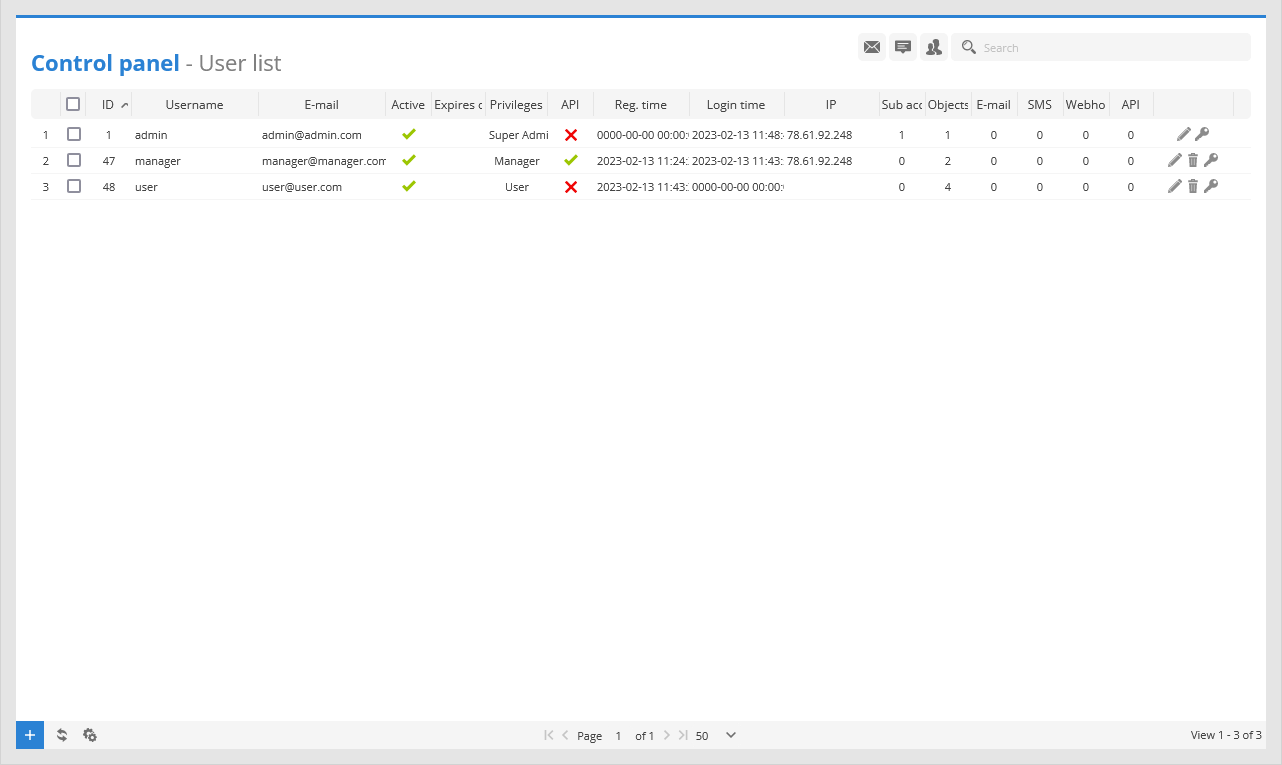
Brief description of User list elements
 – send an email to all or selected Hosted server users.
 – send a pop-up message to all or selected Hosted server users.
 – open a list of all sub-accounts created by all users, with search.
Search – search users by Username, E-mail, or Privileges.
Username – usernames of Hosted server users.
E-mail – email addresses of Hosted server users.
Active – whether the account is active or deactivated.
Expires on – account expiration date.
Privileges – privileges assigned to the account.
API (status) – whether the API feature for the account is enabled or disabled.
Reg. time – date and time when the account was created.
Login time – last login time to the Hosted server.
IP – IP address from which the user last connected.
Sub. acc. – number of sub-accounts created under the user account.
Objects – number of objects connected to the user account.
E-mails sent – number of emails sent from the user account.
SMS – number of SMS messages sent from the user account (notifications or SMS commands).
Webhook – number of webhook requests made by the user account.
API calls – number of API calls made by the user account.
 – open the User properties menu.
 – delete the user account.
 – allow an administrator to access the user’s Workspace.
 – add a new User account.
 – refresh the user account list.
 – open the Actions menu:
 – activate selected user accounts.
 – deactivate selected user accounts.
 – set expiration for selected user accounts.
 – open the bulk settings menu.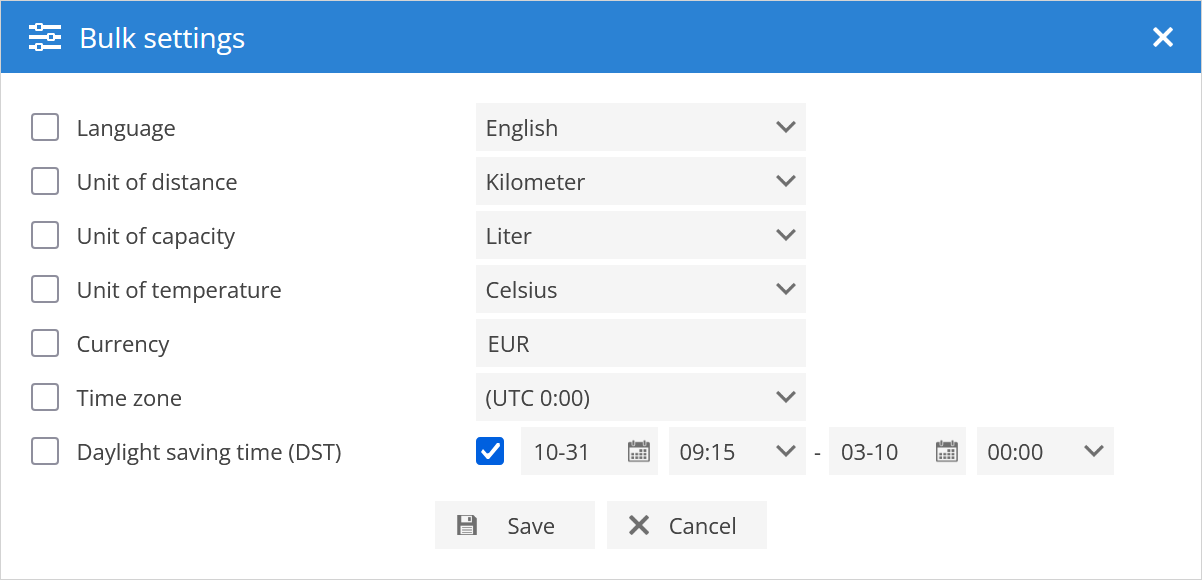
Bulk settings allow you to set:
Language – select the language of the user interface.
Unit of distance – choose miles or kilometers.
Unit of capacity – choose liters or gallons.
Unit of temperature – choose Celsius or Fahrenheit.
Currency – set the currency shown in fuel consumption costs.
Time zone – set the device’s operating time zone. All times will be displayed in the selected time zone. Ensure your GPS device time zone is set to UTC+0.
Daylight Saving Time (DST) – define start and end dates for DST if applicable (clocks advance by one hour during summer months).
 – import a user list from a prepared CSV file. An example file can be downloaded
 here.- – delete selected user accounts.